
 Veselin Stoyanov12 min read
Transitioning from Beginner to Advanced Sauna User
Learn how to build a sauna routine safely by tracking sauna duration, temperature, recovery, and your body's response over time.
Transitioning from Beginner to Advanced Sauna User
A more advanced sauna routine is not necessarily the hottest or longest routine. It is a routine you can repeat consistently, recover from comfortably, and adjust based on useful information rather than guesswork.
For many people, progressing from beginner to advanced sauna user means gradually increasing sauna duration, becoming more consistent with sauna time and temperature, and learning how different conditions affect their energy, sleep, hydration, and recovery.
The safest approach is to change one variable at a time. Start with a manageable routine, record what happened, and only progress when your previous level feels familiar and sustainable.
Important: Sauna use can be stressful for the cardiovascular system and may not be appropriate for everyone. If you have heart disease, uncontrolled high blood pressure, a condition that affects temperature regulation, are pregnant, take medication that affects sweating or blood pressure, or have other medical concerns, ask a qualified healthcare professional before changing your routine. Leave the sauna immediately if you feel dizzy, weak, short of breath, confused, or unwell. (health.harvard.edu)
What separates a beginner routine from an advanced one?
A beginner usually focuses on learning the basics:
- How their body responds to heat
- How long they can stay comfortable
- How much water they need afterward
- How to cool down and recover
- Which sauna environment they are using
An advanced user focuses more on repeatability and feedback. They may have a regular schedule, understand their preferred sauna time and temperature, and know when to maintain, reduce, or skip a session.
The difference is not simply intensity. An advanced sauna routine should give you better control and awareness, not pressure to tolerate discomfort.
Start with a baseline before progressing
Before increasing temperature or time, establish a baseline for at least a few sessions. The goal is to find a level that feels manageable and produces a consistent response.
Record:
- Sauna type, such as traditional or infrared
- Temperature, if available
- Session duration
- Number of rounds
- Cooling method and approximate cooling time
- Hydration before and after
- Notes about energy, dizziness, headache, nausea, sleep, or recovery
A simple baseline might be one short session at a moderate setting, followed by a gradual cool-down and normal hydration. The exact starting point depends on the sauna, your experience, and your health context. If you are new, starting with around five minutes and adding time gradually is a commonly recommended approach; many general safety recommendations keep a session near 15–20 minutes rather than treating longer exposure as automatically better. (health.clevelandclinic.org)

Establish a baseline by recording temperature, duration, and how you feel.
A baseline gives you something to compare against. Without one, it is difficult to tell whether a change in temperature, duration, hydration, sleep, exercise, or stress caused a different result.
Progress one variable at a time
The simplest progression rule is to change either sauna duration or temperature, but not both in the same session.
For example, if you usually complete 10 minutes at your current temperature, you might test a slightly longer session while keeping the temperature unchanged. After several comfortable sessions, you could return to your original duration and test a modest temperature increase.
This approach helps you understand what your body is responding to. If you increase both variables at once and feel unwell, you will not know which change was responsible.
Option 1: Increase duration gradually
Increasing time can be easier to measure than increasing temperature, especially when the sauna setting is fixed.
A cautious progression could look like this:
- Begin with a duration you can complete without significant discomfort.
- Repeat that duration for several sessions.
- If recovery is normal, add a small amount of time.
- Maintain the new duration until it feels familiar.
- Reduce or return to your baseline if symptoms appear or recovery worsens.
You do not need to reach the maximum time available. A shorter session that fits your routine and leaves you feeling well may be more useful than an ambitious session you avoid repeating.
Option 2: Increase temperature gradually
If you control the temperature, increase it in small steps while keeping duration and the rest of the routine stable.
Temperature readings can vary between sauna types, locations, and thermometers, so use the reading as one piece of information rather than a perfect measure of heat exposure. Humidity, airflow, bench height, body position, and whether you are using steam can all affect how intense the session feels.
If a temperature increase makes the same duration feel substantially harder, treat that as a real change in workload. You may need to shorten the session rather than trying to preserve your previous time immediately.
Option 3: Add consistency before intensity
Some people try to progress by making every session harder. A more sustainable approach is to improve consistency first.
For example, an occasional 20-minute session may be less useful for habit-building than several shorter sessions that you can recover from comfortably. Once your routine is stable, you can decide whether a modest change in duration or temperature makes sense.
Use recovery as a progression signal
The most useful question after a session is not simply, “How long did I stay in?” It is, “How did I respond afterward?”
Pay attention to:
- Whether you felt normal after cooling down
- Headache, nausea, dizziness, or unusual weakness
- Excessive thirst or signs that you may be dehydrated
- Sleep that night and energy the following day
- Whether the session interfered with work, exercise, or normal activities
- How quickly you felt ready for your next session
A session may have been too demanding if you feel unwell during it, remain unusually fatigued afterward, or need much longer than expected to recover. Feeling uncomfortable is not a requirement for progress.
Harvard Health advises avoiding sauna use when ill, cooling down gradually, avoiding alcohol and medications that may impair sweating or increase overheating risk, and leaving the sauna if you feel unwell. It also recommends discussing sauna use with a clinician if you have uncontrolled high blood pressure or heart disease. (health.harvard.edu)
A practical progression framework
The following framework is designed to help you make decisions without chasing extreme numbers.
Phase 1: Learn your response
Use a short, comfortable session and focus on technique. Learn how to enter hydrated, where you feel most comfortable sitting, and how your body feels during the first few minutes.
Your goal is not to test your limit. It is to finish with a clear understanding of how the session affected you.
Phase 2: Repeat the baseline
Repeat a similar session several times. Keep the duration, temperature, and number of rounds reasonably consistent.
This creates a useful comparison point. If every session is different, your notes may be interesting but less useful for deciding when to progress.
Phase 3: Make one small adjustment
Choose one change:
- Add a small amount of time
- Increase the temperature modestly
- Add another round only if your current format is already comfortable
- Improve the spacing between sessions
Do not make several changes at once. Keep the rest of the routine as consistent as practical.
Phase 4: Review before repeating the change
Look at how you responded during the session, later that day, and the next day. If the adjustment was comfortable and recovery remained normal across multiple sessions, you may choose to maintain it or make another small change later.
If the response was poor, go back to the last comfortable level. That is not failure; it is useful feedback.
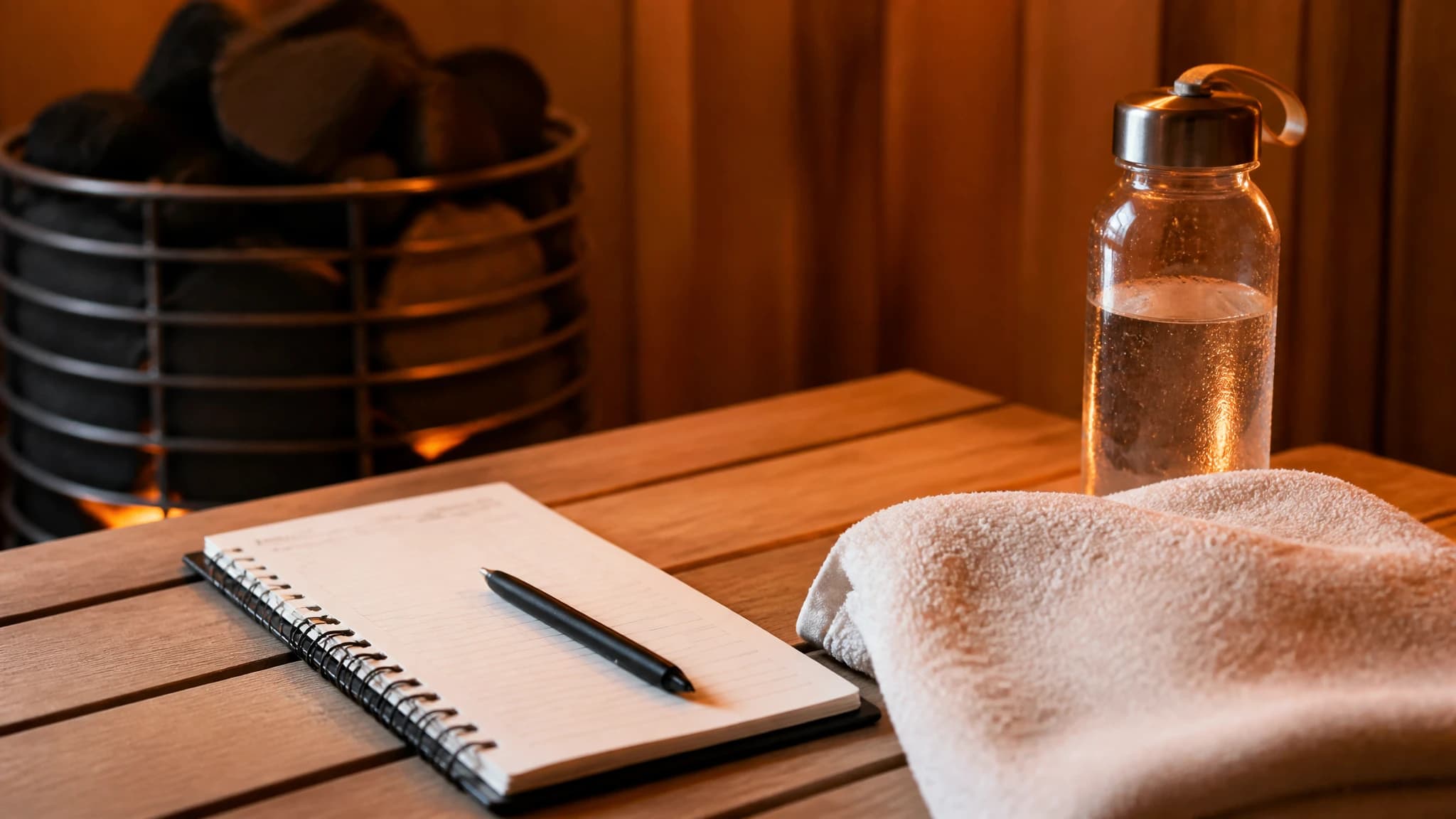
Reviewing your sauna history can reveal patterns in duration, temperature, and recovery.
How sauna logs can guide progression
Memory is not always reliable, especially when sessions are separated by several days. A written log can show patterns that are difficult to notice in the moment.
For example, your history might show that:
- Longer sessions are comfortable only at a lower temperature
- Higher temperatures affect your sleep when used late at night
- You recover well from one round but not from multiple rounds
- You tolerate heat better after a rest day than after intense exercise
- Headaches appear when hydration or food intake is different
- A particular duration works well when repeated consistently
SaunaMetrics is designed for this kind of routine tracking. You can log sessions, temperature, and notes, then review your history over time. The purpose is not to produce a universal “advanced” score. It is to help you see your own patterns and make more informed adjustments.
A useful review question is: What changed between my comfortable sessions and my difficult sessions? Compare duration, temperature, number of rounds, time of day, hydration notes, exercise, sleep, and how you felt afterward.
A sample beginner-to-advanced progression
This is an example structure, not a prescription. Adjust it to your sauna, experience, health situation, and professional guidance.
Weeks 1–2: Establish a comfortable routine
- Use one manageable session format.
- Keep the duration short enough that you can finish without distress.
- Record temperature and how you felt afterward.
- Focus on learning your recovery pattern.
Weeks 3–4: Repeat before increasing
- Keep the same general duration and temperature.
- Aim for consistency rather than intensity.
- Review whether you experienced dizziness, headache, unusual fatigue, or poor sleep.
- If recovery is consistently comfortable, consider one small adjustment.
Weeks 5–6: Test one progression
- Increase either duration or temperature, not both.
- Keep the number of rounds and cooling routine similar.
- Record the change clearly so you can compare it with your baseline.
- Return to the previous level if the new setting is not well tolerated.
After week 6: Maintain, refine, or reduce
An advanced routine may involve maintaining the same setting for months. You can also adjust based on season, sleep, exercise load, travel, illness, or changes in health.
Progression is not always upward. Reducing sauna time after a demanding training week or skipping a session while ill can be a sign of good judgment, not lost progress.
Common mistakes when trying to advance
Chasing a number
There is no single duration or temperature that makes someone an advanced sauna user. A number without context does not tell you how well you tolerated the session or recovered afterward.
Increasing everything at once
Higher temperature, longer duration, more rounds, and shorter cooling periods can create a much larger change than expected. Change one factor so you can learn from the result.
Ignoring early warning signs
Dizziness, weakness, nausea, breathing difficulty, confusion, or feeling faint are reasons to leave the sauna. Do not treat these symptoms as evidence that the session is working. Cleveland Clinic similarly advises exiting when you feel unwell, dizzy, weak, short of breath, or uncomfortable. (health.clevelandclinic.org)
Treating hydration as an afterthought
Sauna sessions involve sweating and fluid loss. Drink according to your needs and follow medical advice if you have a condition that affects fluid or electrolyte balance. Harvard Health recommends drinking cool water after a session and avoiding alcohol around sauna use. (health.harvard.edu)
Comparing different sauna types directly
A 15-minute infrared session and a 15-minute traditional sauna session are not necessarily equivalent experiences. Track the sauna type and temperature so your comparisons are more meaningful.

Recovery is part of the routine, not an afterthought.
When to hold steady or stop progressing
Stay at your current level when the routine feels sustainable and your recovery is predictable. You do not need to progress simply because you have completed a certain number of sessions.
Pause progression if you are sick, sleeping poorly, unusually fatigued, dehydrated, recovering from intense exercise, or noticing new symptoms. If you have a medical condition, take medication that may affect sweating or blood pressure, or are unsure whether sauna use is appropriate, ask a healthcare professional for individualized guidance. (health.harvard.edu)
The best long-term sauna routine is one that you can understand and manage. Use temperature and duration as tools, but let consistency, recovery, and your personal response guide the next step.