
 Veselin Stoyanov10 min read
The Ultimate Sauna Protocol for Workout Recovery
Build a practical sauna protocol for workout recovery with hydration, timing, cooling, and tracking steps—plus important safety guidance.

A sauna can be a useful addition to a recovery routine—but it should complement the basics, not replace them. After training, your priorities are still adequate fluids, food, sleep, and a sensible training schedule. Sauna adds another controlled heat stress, which means the best protocol is measured, repeatable, and easy to adjust.
This guide explains how to build a sauna protocol for recovery after strength, hypertrophy, or conditioning sessions. It focuses on practical steps rather than promising that sauna will automatically speed up every type of recovery. Research is still mixed: one small study found that a post-exercise infrared sauna session reduced soreness and helped preserve next-day explosive performance after resistance exercise, while another study found that repeated post-exercise sauna sessions could impair next-day swim performance after intense training. (pubmed.ncbi.nlm.nih.gov)
What a recovery sauna protocol should accomplish
A useful protocol should help you:
- Rehydrate instead of extending post-workout dehydration.
- Transition gradually from intense exercise to rest.
- Use a manageable heat dose rather than chasing exhaustion.
- Notice how sauna affects soreness, sleep, energy, and next-day performance.
- Repeat what works and modify what does not.
The goal is not to stay in the sauna as long as possible. The goal is to finish feeling calmer and recovered—not light-headed, depleted, or unusually fatigued.
The core sauna protocol for recovery
Use the following as a starting framework for a healthy adult who already tolerates sauna exposure. Adjust the temperature and duration to your facility, experience level, and medical guidance.
Step 1: Finish the workout and cool down for 5–10 minutes
Do not walk directly from an all-out interval or heavy conditioning session into a hot sauna. Spend several minutes walking slowly, breathing normally, and allowing your heart rate to begin settling.
This is also the point to assess yourself. If you feel dizzy, nauseated, confused, unusually weak, or chilled despite feeling overheated, skip the sauna and begin recovery instead.
Step 2: Replace fluids before entering
Drink fluids after training and before the sauna. The exact amount depends on your body size, sweat rate, workout duration, climate, and what you consumed during training. Avoid treating sauna as a way to create rapid weight loss; sauna-induced weight loss is primarily fluid loss and can reduce physical performance when dehydration becomes significant. (pubmed.ncbi.nlm.nih.gov)
For longer or particularly sweaty sessions, a meal or drink containing sodium and carbohydrates may be more useful than plain water alone. Avoid alcohol before or after sauna use; alcohol and heat can both contribute to problems with fluid balance and temperature regulation. (heart.org)
Step 3: Start with 10–15 minutes
For recovery, begin with one moderate round of approximately 10–15 minutes. If you are new to sauna, choose the shorter end of that range. Experienced users may tolerate longer sessions, but a longer exposure is not automatically a better recovery strategy.
Stay seated, keep your breathing relaxed, and leave if you feel unwell. Do not use the clock to override symptoms.
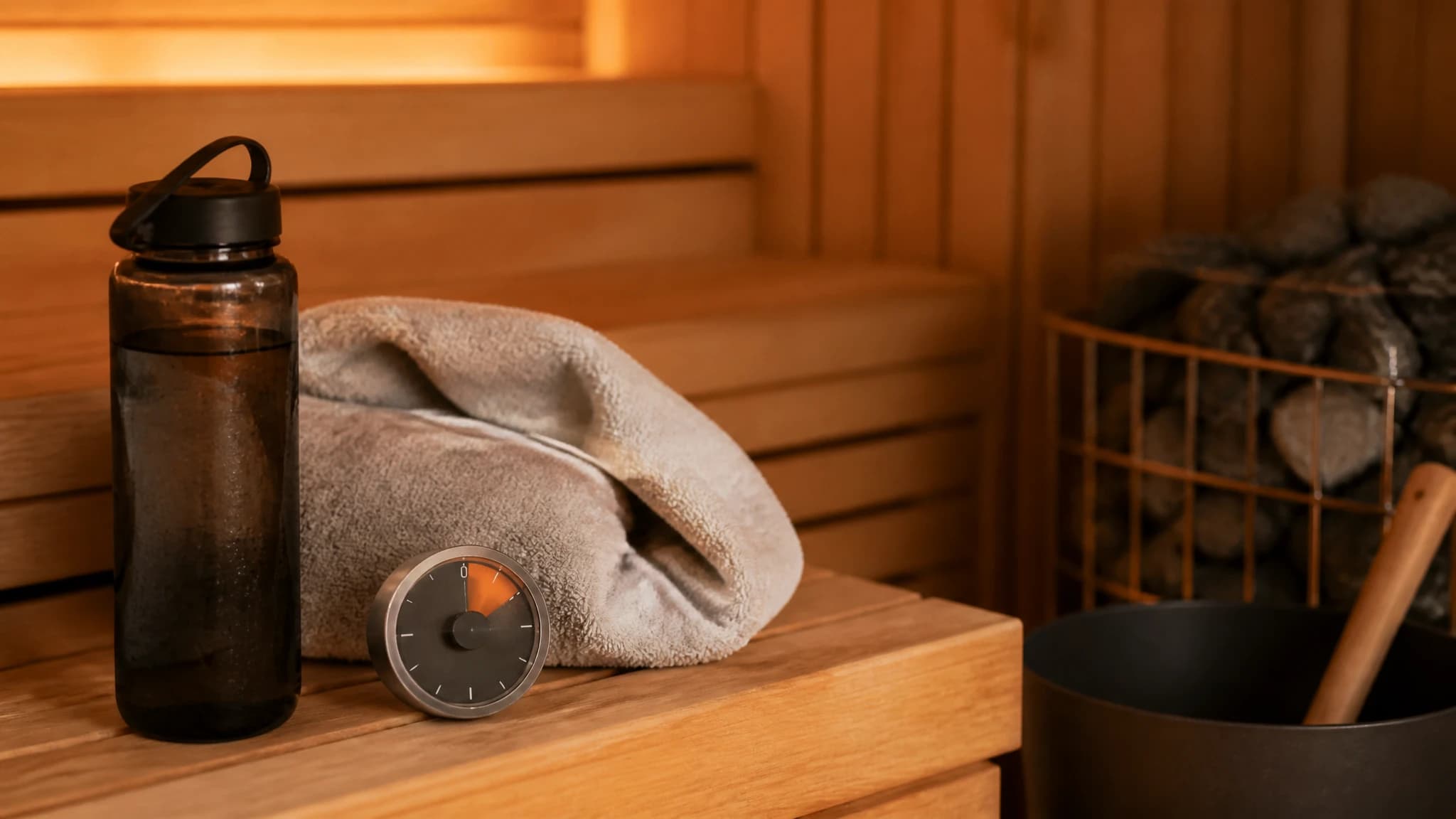
Prepare fluids and keep the first sauna round moderate.
Step 4: Cool down gradually for 10–15 minutes
After leaving the sauna, sit or walk slowly in a comfortable-temperature area. Drink more fluids and allow your breathing and heart rate to settle. A lukewarm or comfortably cool shower can be used if it helps you feel refreshed.
You do not need an extreme cold plunge to complete a recovery protocol. In particular, people with high blood pressure should ask a healthcare professional about sauna use and avoid rapidly moving between extreme heat and cold without appropriate guidance. (heart.org)
Step 5: Add light mobility, not more punishment
Once you feel stable, perform 5–10 minutes of easy mobility: gentle walking, controlled range-of-motion work, or relaxed stretching. Avoid turning this into another hard session. The purpose is to leave the gym feeling better prepared for rest, not to accumulate more fatigue.
Step 6: Log the session and evaluate the next day
Record the details that make the protocol repeatable:
- Workout type and perceived difficulty.
- Sauna temperature, if available.
- Time spent in the sauna.
- Number of rounds.
- Fluids consumed before and after.
- Soreness, energy, sleep quality, and next-day performance.
SaunaMetrics can help you log sessions, temperature, notes, and routines over time. That makes it easier to compare a single 12-minute round with a longer protocol instead of relying on memory.
Protocol variations for different workouts
The best sauna protocol for recovery depends on what you trained and what is scheduled next.
After strength or hypertrophy training
Try:
- Five to ten minutes of easy cool-down.
- Fluids and a normal post-workout meal or snack.
- One 10–15-minute sauna round.
- Ten minutes of gradual cooling.
- Light mobility and a normal evening recovery routine.
If soreness and sleep improve without a drop in next-day strength, you may experiment with a second short round on a separate day. Avoid increasing both duration and frequency at the same time.
A 2023 crossover study involving male basketball players reported lower subjective soreness and better perceived recovery after a single 20-minute infrared sauna exposure following resistance exercise, but the study was small and used a specific infrared setup. Treat those findings as encouraging—not as a universal prescription. (pubmed.ncbi.nlm.nih.gov)
After a high-intensity interval workout
Use a more conservative approach:
- Cool down until breathing is controlled.
- Rehydrate and replace electrolytes as appropriate.
- Start with 5–10 minutes of sauna exposure.
- Cool down fully and reassess.
- Skip a second round if you feel drained.
Intervals already create substantial cardiovascular and thermal stress. If you have another demanding workout or competition the next day, passive rest may be the better recovery choice. In one study of competitive swimmers and triathletes, three 8-minute sauna rounds after intense training were followed by worse next-morning swim performance than a comparison recovery condition. (pubmed.ncbi.nlm.nih.gov)
After endurance training
For an easy or moderate endurance session, one 10–20-minute round may be reasonable if you are well hydrated and accustomed to heat. After a long run, race, or hot-weather workout, shorten the session or skip it entirely until fluids, food, and body temperature have normalized.
Post-exercise sauna has also been studied as a heat-acclimation tool, with some research using approximately 25–30 minutes several times per week in trained runners. That is a specific training intervention, not a default recovery prescription, and it should be planned carefully. (pubmed.ncbi.nlm.nih.gov)
On a rest day
A rest-day sauna session may be easier to tolerate than one immediately after a demanding workout. Use it as a standalone routine:
- Eat and hydrate normally.
- Enter when you feel rested and well.
- Complete one 10–20-minute round.
- Cool down gradually.
- Track sleep and next-day readiness.
This can help you determine whether the sauna itself feels beneficial, separate from the effects of a hard workout.
How often should you use sauna for recovery?
Start with one or two sessions per week for two weeks. Keep the protocol consistent so you can evaluate it. If you feel good and your training quality remains stable, you can consider adding another session.
Change only one variable at a time:
- Duration.
- Number of rounds.
- Weekly frequency.
- Timing after training.
- Sauna temperature.
If you change everything at once, you will not know what caused an improvement—or a setback. Track your response for at least several sessions before drawing conclusions.
Signs your protocol is too aggressive
Reduce the heat dose or stop using sauna after workouts if you notice:
- Dizziness or faintness.
- Headache, nausea, or confusion.
- Unusual fatigue later that day.
- Poor sleep or elevated restlessness.
- A clear decline in next-day training performance.
- Persistent thirst, dark urine, or other signs that you have not replaced fluids.
Heat exhaustion can include weakness, dizziness, headache, muscle cramps, and a fast, weak pulse. Confusion, loss of consciousness, or inability to drink requires urgent medical attention. (mayoclinic.org)
Who should get medical guidance first?
Talk with a healthcare professional before adding sauna to post-workout recovery if you have cardiovascular disease, uncontrolled blood pressure, a history of fainting, kidney disease, or a condition or medication that affects fluid balance or heat tolerance. Some medications, including certain diuretics and cardiovascular medicines, can change how the body responds to heat. Do not change medication use to accommodate sauna. (heart.org)
Never combine sauna with alcohol, and do not use it when you are ill, significantly dehydrated, or unable to recognize and respond to warning symptoms.

Cooling down gradually is an important part of the recovery protocol.
A simple four-week progression
If you want a repeatable plan, use this conservative progression:
Week 1: One 10-minute round after an easy or moderate workout.
Week 2: One 12–15-minute round after one or two suitable sessions.
Week 3: Keep the same duration and add a second day only if sleep, energy, and training performance remain normal.
Week 4: Test one slightly longer session—up to about 20 minutes—or keep the existing protocol and compare your results.
Do not progress during a week that includes unusually high training volume, a competition, illness, poor sleep, or hot outdoor conditions.
The practical takeaway
The ultimate sauna protocol for workout recovery is not the hottest or longest routine. It is a controlled process: cool down, replace fluids, use a moderate heat dose, cool down gradually, move lightly, and track what happens next.
Start with one short round and judge the protocol by useful outcomes—better relaxation, manageable soreness, good sleep, and stable training performance. If sauna leaves you depleted or affects your next workout, reduce the dose or use it on a separate rest day.