
 Veselin Stoyanov10 min read
Sauna Tolerance Tracking: A Practical Way to Understand Your Heat Routine
Learn how sauna tolerance tracking can help you understand temperature, session length, comfort, hydration, and recovery without pushing past warning signs.

Sauna Tolerance Tracking: A Practical Way to Understand Your Heat Routine
Sauna tolerance is not a score you need to maximize. It is a practical way to describe how your body and mind respond to a particular sauna routine, including the heat, session length, humidity, hydration, and recovery afterward.
That response can vary. A temperature that feels manageable one day may feel excessive after poor sleep, a hard workout, travel, illness, or inadequate hydration. Sauna tolerance tracking helps you notice those patterns without turning every session into a test of endurance.
The goal is awareness: understanding what makes a sauna session feel manageable, what affects recovery, and when to stop. Tracking should never encourage you to ignore dizziness, nausea, unusual weakness, chest discomfort, confusion, or any other warning sign.
What does sauna tolerance mean?
In everyday, non-medical terms, sauna tolerance is your observed ability to remain comfortable and recover normally during and after a sauna session at a specific intensity.
It includes more than the number on the thermometer. Two sessions at the same temperature may feel very different depending on:
- Session length
- Humidity or steam exposure
- Whether you recently exercised
- Food and fluid intake
- Sleep and general energy
- How quickly you cool down
- Your comfort and symptoms during the session
- How you feel later that day and the next morning
This is why a single “ideal” temperature or duration is rarely useful for everyone. Your notes are more valuable when they describe your own experience in context.
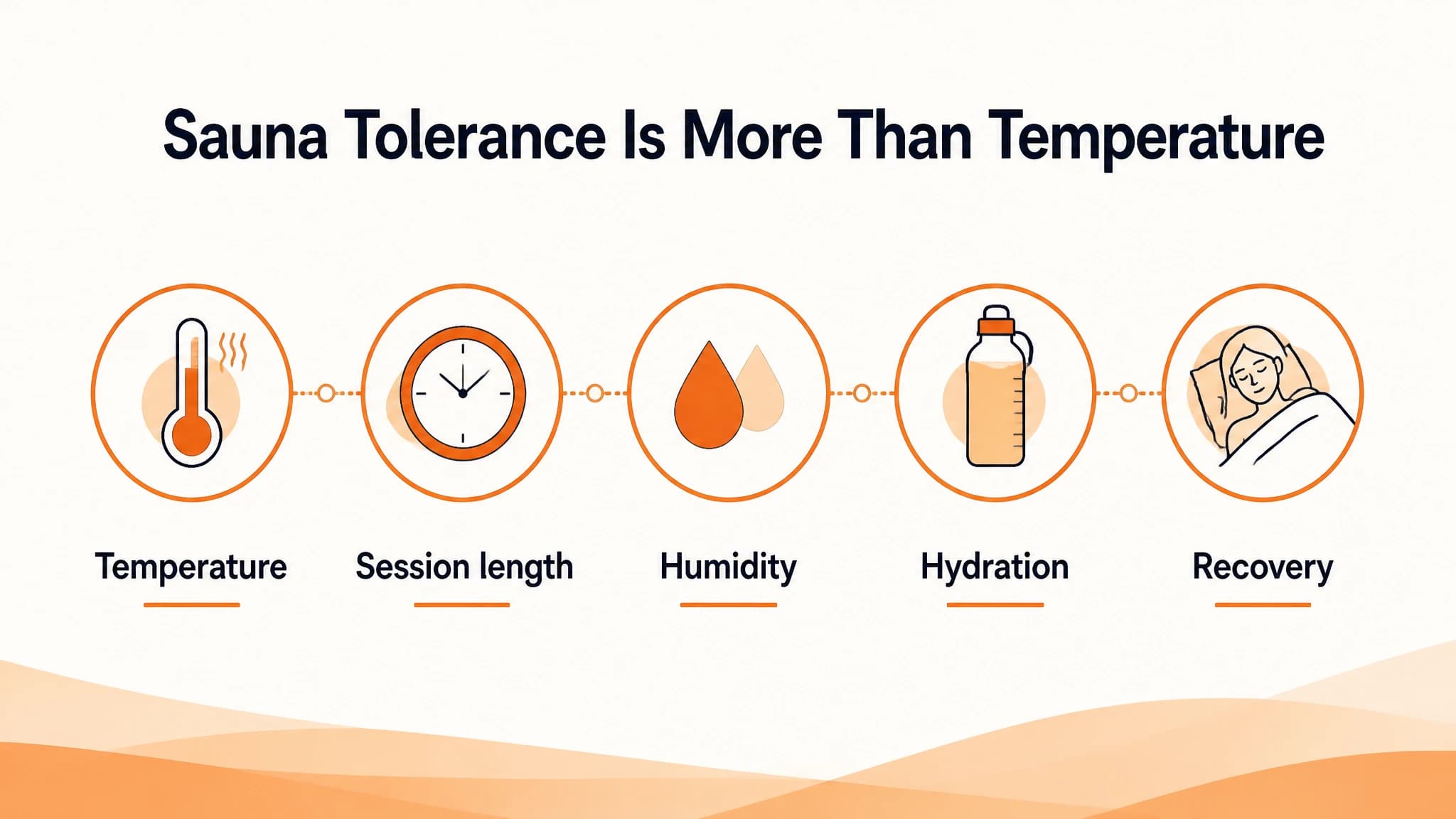
Temperature is only one part of how a sauna session feels.
Why track your sauna tolerance?
A simple record can turn vague impressions into useful observations. Instead of thinking, “That session felt rough,” you may eventually see that longer sessions after intense exercise consistently lead to slower recovery, or that a slightly cooler session is easier to repeat during a busy week.
Tracking can help you:
- Recognize repeatable routines. You can compare sessions and identify combinations of temperature, duration, and timing that feel sustainable.
- Notice changes early. A sudden shift in comfort or recovery may be a reason to pause, reduce intensity, or consider whether another factor is affecting you.
- Avoid relying on memory. Small details are easy to forget, especially when sessions are separated by several days.
- Build consistency without chasing extremes. A routine you can repeat comfortably is often more useful than an occasional session that leaves you depleted.
- Ask better questions. If you speak with a qualified healthcare professional about sauna use, clear notes may help you describe what you experienced.
For a broader introduction to recording sauna habits, see this guide to a sauna tracking app. The same principles can also be followed with a paper journal or a basic notes app.
What to record after each session
You do not need a complicated spreadsheet. Start with a few consistent fields and add detail only when it helps explain your response.
1. Temperature
Record the approximate sauna temperature if it is available. If the reading changes during the session, note the range rather than pretending it was perfectly constant.
Temperature is useful for comparison, but it should not be treated as a target you must reach. Sauna types, room design, thermometer placement, humidity, and personal conditions can all affect how a session feels.
2. Session length
Write down how long you stayed in the sauna and whether you took breaks. A single uninterrupted session and two shorter rounds may create very different experiences, even if the total time is similar.
Use a timer if you tend to lose track of time, but do not let the timer override your symptoms. Leaving early is a useful decision when the session no longer feels comfortable.
3. Perceived comfort
A simple comfort scale can make your notes easier to compare. For example:
- 1: Very uncomfortable or stopped early
- 2: Uncomfortable and difficult to settle
- 3: Manageable but demanding
- 4: Comfortable and controlled
- 5: Comfortable, with plenty of room to stop
This is not a medical measurement. It is a personal description of how the session felt. Add a short note if the number needs context, such as “comfortable at first, then increasingly lightheaded.”
4. Recovery after the session
Record how you felt immediately afterward and later in the day. Useful observations may include whether you felt refreshed, tired, thirsty, chilled, headachy, or unusually drained.
You can also note how long it seemed to take before you felt back to your normal baseline. Avoid treating a particular recovery time as a universal standard. The purpose is to compare your own responses across similar sessions.
5. Hydration and related context
Note whether you drank fluids before and after the session, especially if hydration appears to affect your comfort. You can also record whether you exercised, consumed alcohol, slept poorly, skipped a meal, or felt unwell.
Avoid turning hydration tracking into a rigid prescription. Fluid needs vary, and people with kidney, heart, liver, or other health conditions may need individualized advice. If you have a relevant medical condition or take medication that affects blood pressure, sweating, or fluid balance, ask a qualified clinician about sauna use.
6. Free-form notes
The most useful detail may not fit into a number. Write down anything that could explain the session:
- “Entered after a long run”
- “Used more steam than usual”
- “Stopped because I felt dizzy”
- “Felt normal again after cooling down”
- “Room was crowded and felt hotter than expected”
- “Slept poorly the night before”
Short notes are enough. The aim is to create a record you will actually maintain.
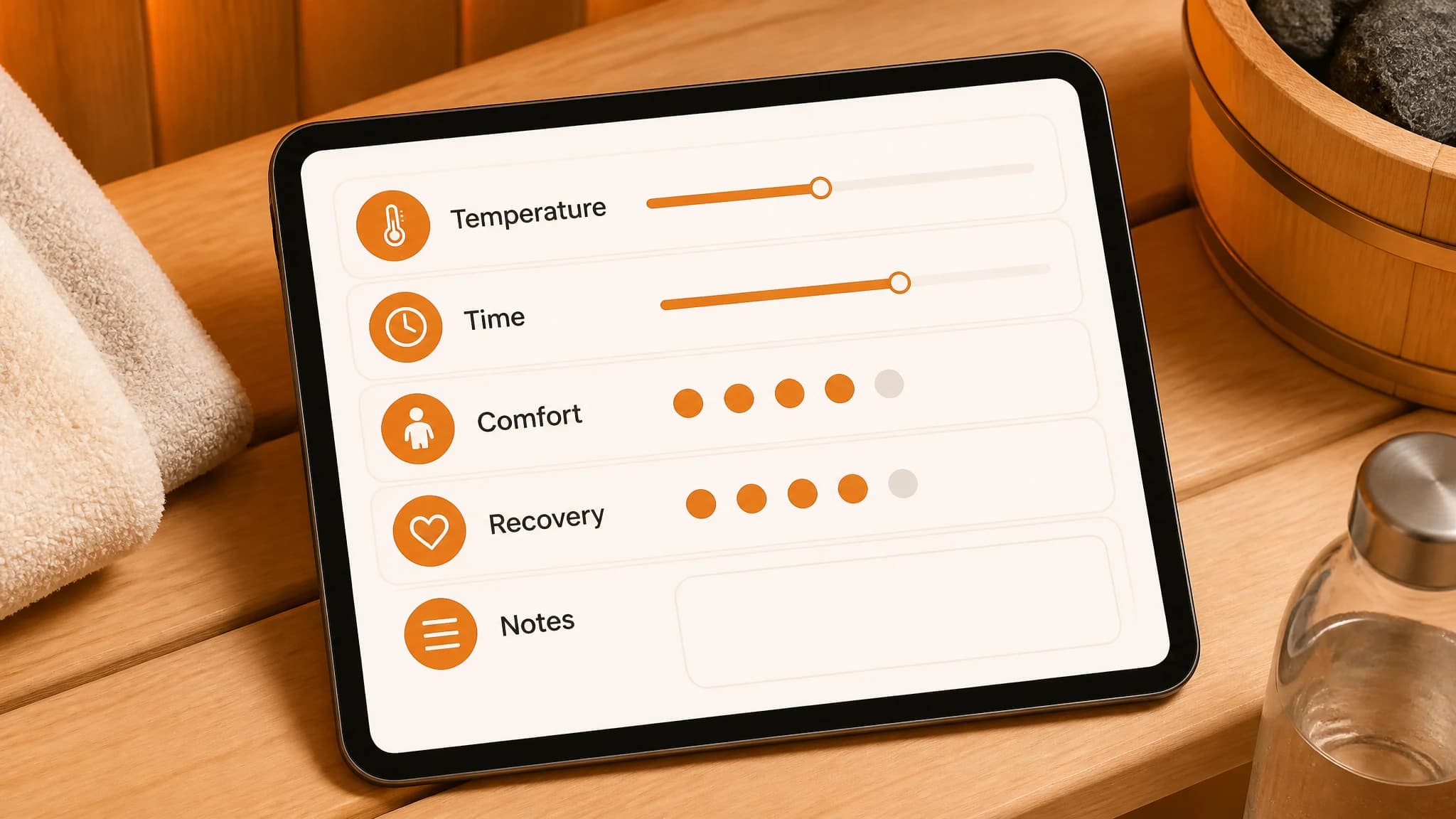
A small, consistent record is easier to maintain than a complicated tracking system.
A simple sauna tolerance tracking template
You can use this format after each session:
Date:
Sauna type:
Approximate temperature:
Humidity or steam:
Session structure:
Total time:
Comfort from 1 to 5:
How I felt during the session:
How I felt immediately afterward:
Recovery later that day or next morning:
Fluids and other context:
What I would repeat or change:
If you prefer fewer fields, begin with temperature, duration, comfort, recovery, and one note. Once those become habitual, you can decide whether additional details are genuinely useful.
SaunaMetrics is a free sauna tracking app designed for logging sessions, temperature, and notes over time. It can be a convenient option if you want your records in one place, but the method matters more than the tool.
How to review your records without overinterpreting them
Review your notes every few weeks rather than judging each session in isolation. Look for patterns that are repeated across several comparable sessions.
Ask questions such as:
- Which session lengths usually feel manageable?
- Do I recover differently after sauna use on workout days?
- Does more humidity change my comfort?
- Do I feel better when I arrive rested and hydrated?
- Are my sessions becoming more consistent, or simply more intense?
- Have I recorded repeated warning signs?
Change one variable at a time when possible. If you change temperature, duration, frequency, and cooling method together, it becomes difficult to know what influenced the result.
A useful review does not ask, “How can I tolerate more heat?” It asks, “What routine can I repeat while remaining comfortable and recovering normally?” For additional ideas, learn how to monitor sauna progress using practical routine metrics.
Tolerance is not the same as progress
It is easy to assume that a longer session or hotter room means improvement. That is not necessarily true. Sauna tolerance tracking is most helpful when it supports informed choices rather than competition with yourself.
Progress may look like:
- Choosing a routine that fits your schedule
- Recognizing when a shorter session is appropriate
- Recovering comfortably between sessions
- Stopping promptly when something feels wrong
- Understanding which conditions make sauna use less enjoyable
- Returning consistently without needing to push intensity
If your notes show that a routine repeatedly leaves you unwell, the answer is not to force adaptation. Reduce the demand, take a break, or seek professional guidance when appropriate.
A tracking plan should never override warning signs or discomfort.
Warning signs should always override your tracking plan
Tracking is a support tool, not permission to continue through symptoms. Leave the sauna if you feel dizzy, faint, confused, nauseated, unusually weak, short of breath, or otherwise unwell. Chest discomfort or severe symptoms require prompt attention rather than another data point.
Harvard Health advises leaving the sauna if you feel extremely hot, lightheaded, or dizzy, cooling down gradually, and replacing fluids afterward. Its guidance also notes that people with certain heart conditions or low blood pressure should be especially cautious and discuss sauna use with a clinician. Read the safety guidance for context, and seek individualized medical advice when your health history or medications may affect heat tolerance.
Do not use a tracking app to diagnose dehydration, heat illness, cardiovascular problems, or any other condition. If symptoms are severe, sudden, recurrent, or do not resolve, seek appropriate medical care.
Making sauna tolerance tracking sustainable
The best tracking system is one that takes less than a minute or two. Consider these habits:
- Enter your notes immediately after cooling down.
- Use the same comfort scale every time.
- Keep descriptions factual and brief.
- Avoid filling in missing data from memory several days later.
- Review patterns periodically instead of checking obsessively.
- Mark sessions that ended early as useful information, not failures.
You can also pair your log with a clear personal rule: symptoms come first, and the planned duration is optional. That simple rule keeps the record focused on awareness and safety.
Conclusion
Sauna tolerance tracking is a practical way to understand how your routine feels under different conditions. By recording temperature, duration, comfort, recovery, hydration context, and short notes, you can make decisions based on observed patterns rather than memory or comparison.
Keep the process simple, change one variable at a time, and treat warning signs as a reason to stop. The goal is not to tolerate the hottest or longest session. It is to develop a sauna routine that is informed, repeatable, and appropriate for you.