
 Veselin Stoyanov10 min read
How to Measure Sauna Tolerance Over Time Without Overdoing It
Learn how to measure sauna tolerance with consistent notes on temperature, duration, comfort, and recovery without pushing too hard.
How to Measure Sauna Tolerance Over Time Without Overdoing It
Sauna tolerance is not a score you need to maximize. It is a practical way to understand how you respond to a particular combination of heat, session length, humidity, hydration, breaks, and recovery.
If you want to measure sauna tolerance, the goal is not to prove that you can stay inside longer than before. A useful measurement process helps you identify a routine that feels manageable, repeatable, and appropriate for you. Longer or hotter sessions are not automatically better, and a difficult session is not necessarily a sign of progress.
The most reliable approach is to keep several variables consistent, record how the session felt, and review your notes over time. This gives you a clearer picture than relying on memory or comparing your routine with someone else's.
What sauna tolerance actually means
Sauna tolerance describes how comfortably and consistently you handle a specific sauna routine. That routine may include:
- The approximate temperature
- Session duration
- Humidity or steam exposure
- Number of rounds
- Time spent cooling down between rounds
- Hydration and food intake around the session
- Sleep, stress, and energy levels
- How you feel during recovery
Tolerance is personal and context-dependent. You may tolerate one temperature well for a short session but feel poorly after several rounds. You may also respond differently on days when you are tired, dehydrated, stressed, or recovering from exercise.
This is why there is no single number that defines good sauna tolerance. Instead, look for patterns in your own records.
For a broader introduction to the idea, see this guide to sauna tolerance tracking.
Start with a baseline instead of trying to improve immediately
Before changing your routine, record a few ordinary sessions as a baseline. A baseline gives you something to compare against and helps prevent you from interpreting one unusually good or difficult session as a meaningful trend.
For each baseline session, note:
- The date and approximate time
- Sauna temperature
- Time spent inside
- Number of rounds, if applicable
- Cooling or rest breaks
- How you felt before entering
- How the session felt while inside
- How you felt immediately afterward
- How you felt later that day and the following morning
Try to collect several sessions under reasonably similar conditions. They do not need to be identical, but comparisons are more useful when you avoid changing temperature, duration, and number of rounds all at once.
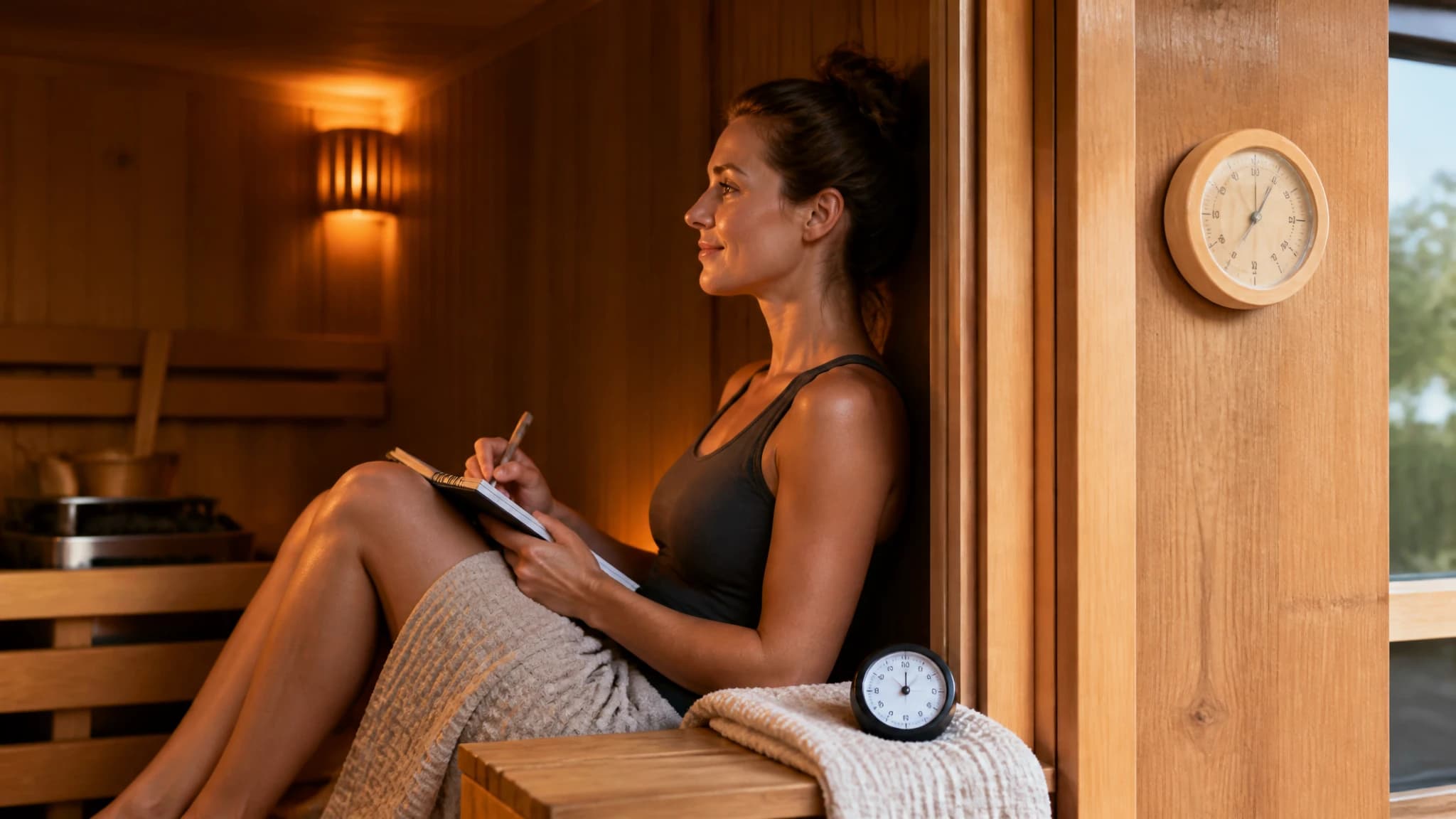
Start by recording ordinary sessions before changing the routine.
A baseline is not a test. Keep the routine within a range that already feels sensible for you, and stop if you experience warning signs such as dizziness, faintness, confusion, unusual weakness, chest discomfort, or difficulty breathing. If you feel unwell, leave the sauna, cool down gradually, and seek appropriate medical advice when needed.
Track the variables that make sessions comparable
The simplest way to measure sauna tolerance is to treat each session as a small observation. You do not need complex equipment or a detailed spreadsheet. You need enough consistent information to answer, “How did I respond to this routine?”
Temperature
Record the approximate sauna temperature and, when relevant, whether the heat felt dry or humid. Two sessions at the same displayed temperature may feel different because of humidity, airflow, seating position, or how recently water was added to the stones.
Temperature should be treated as one part of the session, not as the entire measure of intensity. A lower-temperature session can still feel demanding if it lasts longer or includes multiple rounds.
Duration
Record the time spent in each round rather than only the total time. For example, three shorter rounds with cooling breaks create a different experience from one continuous session of the same total duration.
When reviewing your notes, look for the duration you can repeat without unpleasant after-effects. A session that you can complete comfortably and recover from is more informative than a longer session that leaves you feeling depleted.
Rounds and recovery breaks
If you use multiple rounds, record how many you completed and how long you rested between them. Also note whether you felt ready to re-enter or whether you continued because you had set an arbitrary target.
The length and quality of the break can change how the next round feels. Cooling method, hydration, room temperature, and time spent resting may all affect your experience.
Perceived comfort or exertion
Use a simple personal scale after each round. For example:
- 1: Very comfortable
- 2: Comfortable
- 3: Manageable but noticeable
- 4: Challenging
- 5: Too intense or a reason to stop
This is not a medical measurement. It is a consistent shorthand for your own experience. You can also record a short description, such as “comfortable until the final five minutes” or “felt more intense than usual despite the same temperature.”
Recovery notes
Recovery is one of the most useful parts of tolerance tracking. Record how you feel immediately after the session, a few hours later, and the next morning when relevant.
Useful observations include:
- Whether you returned to your usual energy level
- Whether you felt refreshed, neutral, or unusually tired
- Whether you had a headache, nausea, or lightheadedness
- Whether you slept normally afterward
- Whether you felt ready for your next planned session
A routine that feels manageable during the sauna but repeatedly disrupts the rest of your day may be too intense for your current circumstances.
Use one-variable changes to identify patterns
Once you have a baseline, make only one meaningful change at a time. You might slightly adjust duration while keeping temperature and rounds similar. Later, you might return to the baseline duration and change temperature instead.
This approach makes it easier to understand what influenced your response. If you increase temperature, duration, and rounds in the same session, you may not know which change caused discomfort or delayed recovery.
A simple comparison might look like this:
| Variable | Baseline | New session |
|---|---|---|
| Temperature | Similar range | Similar range |
| Duration | 12 minutes | 15 minutes |
| Rounds | 1 | 1 |
| Comfort | Manageable | Challenging near the end |
| Recovery | Normal | More tired afterward |
The result does not automatically mean that 15 minutes is unsafe or that you should never try it again. It simply tells you that the longer session produced a different response under those conditions. You can repeat it later, return to baseline, or adjust another factor based on your goals and comfort.
For a more structured approach to changing variables, read about creating a personalized sauna protocol.
Look for repeatable trends, not isolated sessions
One unusually easy session does not necessarily mean your tolerance has improved. Likewise, one difficult session does not necessarily mean you have lost tolerance. Daily conditions matter.
When reviewing your records, ask:
- Do similar sessions feel more comfortable over several attempts?
- Can you repeat the routine without accumulating unusual fatigue?
- Is your recovery becoming more predictable?
- Are warning signs becoming more frequent?
- Does a change only work when you are exceptionally well-rested?
- Are you choosing a harder session because it feels appropriate, or because you feel pressure to progress?
A positive trend may look modest. You might notice that the same session feels less distracting, that you recover more consistently, or that you can make a small adjustment without disrupting your normal day. These observations are more useful than chasing a maximum time or temperature.
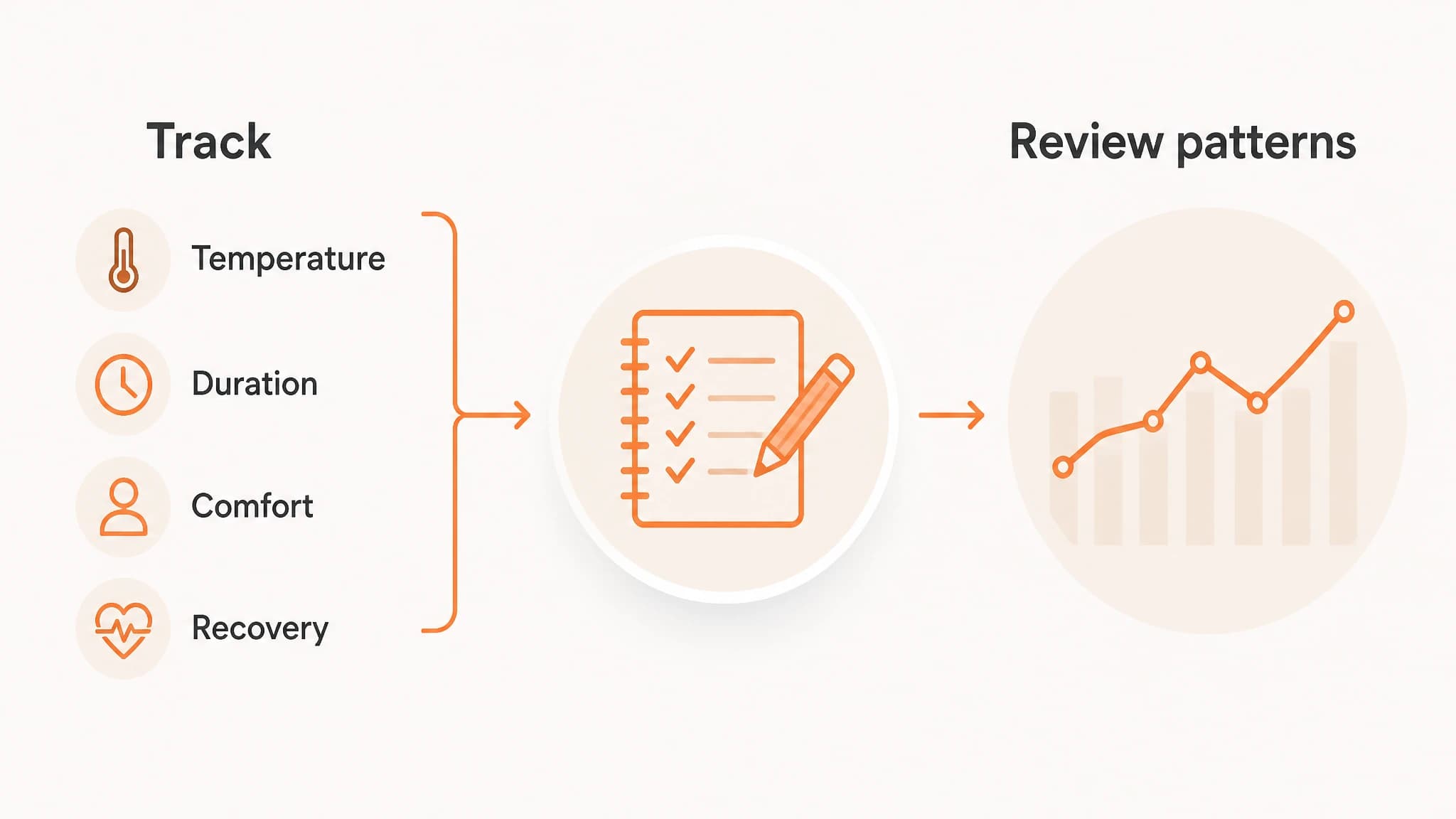
Compare temperature, duration, comfort, and recovery across similar sessions.
Know when to stop or reduce intensity
Measuring tolerance should never require ignoring your body's signals. Leave the sauna and reduce or pause the routine if you experience symptoms such as dizziness, faintness, confusion, nausea, unusual weakness, severe headache, chest discomfort, or trouble breathing.
You should also consider reducing intensity when:
- You feel unwell before entering
- You are unusually dehydrated
- You are recovering poorly from a previous session
- Your sleep or energy is noticeably worse afterward
- You repeatedly need to cut sessions short
- You feel pressure to continue despite discomfort
Do not treat warning signs as a challenge to overcome. If symptoms are severe, persistent, or concerning, seek medical care. People with medical conditions, those who are pregnant, and people taking medications that affect blood pressure, fluid balance, or heat response should ask a qualified healthcare professional for individualized guidance before changing sauna exposure.
Make your tracking routine easy enough to maintain
The best tracking system is one you will actually use. A short note after each session may be enough. Consider creating a repeatable template with these fields:
- Temperature
- Duration
- Rounds
- Break length
- Comfort or exertion rating
- Pre-session condition
- Immediate recovery
- Later recovery
- One sentence about anything unusual
Avoid recording more detail than you can review. If your notes become a burden, you may stop tracking before you have enough information to see a pattern.
SaunaMetrics can help with this process as a free sauna tracking tool. You can log sessions, temperature, and notes, then review your routine over time instead of relying entirely on memory.
Review your history before making the next change
Set aside time every few sessions to review your notes. You are looking for practical decisions, not a perfect score.
For example, your review may lead you to:
- Keep the current routine because it is comfortable and repeatable
- Shorten sessions when recovery is consistently poor
- Add more rest between rounds
- Return to a familiar temperature after an uncomfortable change
- Avoid progression during periods of poor sleep or high stress
- Test one small adjustment under similar conditions
This process keeps the focus on sustainable sauna use. Your tolerance may change with seasons, schedule, training load, sleep, hydration, and general health. A routine that works well now may need to be adjusted later.
Tolerance is not the same as progress
It is easy to assume that hotter, longer, or more frequent sessions represent improvement. That assumption can encourage unnecessary risk and make sauna use feel like a performance test.
A better definition of progress is increased understanding. You may learn which conditions support a comfortable session, how much recovery you need, and which signals mean you should stop. You may also discover that your preferred routine is shorter or gentler than someone else's.
The most useful sauna routine is one that fits your circumstances and can be repeated responsibly. Measuring sauna tolerance helps you make that routine more informed without turning every session into a test of endurance.